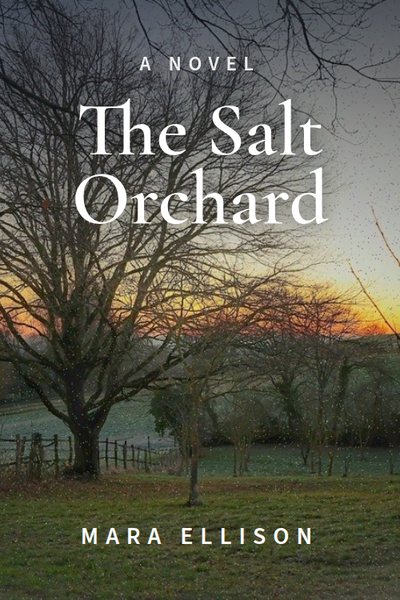

Early in The Salt Orchard, Tess Pell walks the lower rows at dusk with a paring knife and cuts open one apple from every tree. She lines the halves up along the stone wall in order, like a doctor laying out X-rays, and tastes each one. By the eleventh tree she has stopped swallowing. "The Baldwins went first," Mara Ellison writes, "and then the Macouns, and then the tree our grandfather planted the year he came home from the war, which had never once failed to bear."
It is a small scene, and it tells you exactly what kind of book this is. Ellison's debut, out September 8 from Harbor Light Press, is a novel of inventory. The three Pell sisters, Hannah, June and Tess, have come home to the family orchard on the Maine coast for a final harvest. Seawater has been creeping into the soil for years. Their mother, who kept the orchard's records in thirty-eight green ledgers, has stopped writing anything down. Over a single autumn the sisters pick what they can, sort the house room by room, and count what is left.
A book that trusts its reader
The first thing to say about Ellison is that she does not hurry. The novel runs 336 pages and covers roughly ten weeks, and there are chapters in which the most dramatic event is a cider press jamming. Her sentences are plain and exact. She knows the names of things, the pickers' ladders and bushel crates and frost pockets, the particular pewter of a Maine harbor in October. She describes salt damage the way a nurse might describe a wound, without flinching and without decoration.
That steadiness pays off in the sisters. Hannah, the eldest, runs a school district office in Portland and treats the harvest like a project with deadlines. Tess, the youngest, has come home from a marriage that ended badly and cannot stop testing the fruit. Their fights are small and specific and ring true. One of the best scenes in the book is an argument over who gets their mother's blue enamel roasting pan that is really an argument about who visited in the last three years.
"We had come home to save the orchard, and the orchard, very politely, was declining to be saved."
Ellison is at her strongest with the mother, Adele, whose silence sits at the center of the book. There is no diagnosis scene and no speech from a doctor. Adele simply stops finishing things. A pie crust left half rolled. A letter addressed and never stamped. The sisters find the blank ledger on the kitchen table and understand, before any of them says it aloud, what it means. "She had written down every frost for forty years," Ellison writes, "and now the frost was in her, and there was no one left to write it down."
Where it drags
This is a quiet book, and I mean that mostly as praise. But the middle third tests a reader's patience in ways that are not always productive. A long subplot about a developer who wants the waterfront acres never comes to life. He exists to deliver an offer and a deadline, and he delivers both more than once. June, the middle sister, also suffers beside the other two. The novel keeps telling us she notices everything, but we rarely learn what she wants. In a book this attentive to its people, her vagueness stands out.
The salt imagery is occasionally pressed too hard as well. Salt in the soil, salt on the sisters' faces, salt in the haddock they fry on the last warm night of the season. By the fifth rhyme a careful reader can feel the author's hand on the page.
An ending that earns its reputation
None of that matters much by the final chapter. Booksellers have started warning customers not to finish this novel on a train, and they are right. The last forty pages take place over a single October night, and they are as controlled and as moving as anything I have read in a debut this year. I will not describe what happens. I will say only that Ellison plants a small, almost domestic image on page twelve and returns to it at the very end, and the return lands like a door closing softly in another room.
Ellison has worked nights as a hospice nurse for most of her adult life, and it shows in the best possible way. She understands that endings are rarely loud. She knows how people behave at kitchen tables in the hours before dawn. She knows that grief often looks like chores. "There is always one more thing to put away," Hannah says near the end, "and then there isn't."
The Salt Orchard is on the 2026 RedSquibble Debut Shortlist. Every sentence in it has been carried a long way.
The Verdict
The Salt Orchard sags in the middle and leans too often on its central image, but its people are real and its ending is close to perfect. Ellison writes about loss with the patience of someone who has sat through a great deal of it. Read it, then buy a second copy for whoever you thought of on the last page.
The Salt Orchard by Mara Ellison (Harbor Light Press, 336 pages, $27) is out now.
Critic. Elena writes reviews and essays on poetry, memoir and the craft of the first book.