
The submissions arrived as hardcovers in padded mailers, as paperbacks with handwritten notes tucked inside, and as galleys of books that are not even in stores yet. By the time the window closed there were 1,140 of them. Our eighteen first readers, a rotating group of booksellers, librarians and editors, spent the spring narrowing that pile to sixty. Since June, our three judges have been reading all sixty.
Today we can share the twelve they chose.
The panel is Wendell Osei, owner of Crooked Stair Books in Burlington, Vermont, Frances Albright, a retired editor who spent three decades acquiring first novels in Chicago, and novelist Rafael Quintero, author of The Winter Census. The longlist spans eleven genres, nine presses and one self-published memoir. Two of the books have not yet reached stores.
"Twelve is already too few," Osei said. "Six is going to hurt."
Quintero said the range surprised him most. "I expected to be comparing novels with novels," he said. "Instead I spent a week trying to decide whether a sonnet can outweigh a locked-room mystery. I still don't know. I loved the problem."
Here are the twelve.
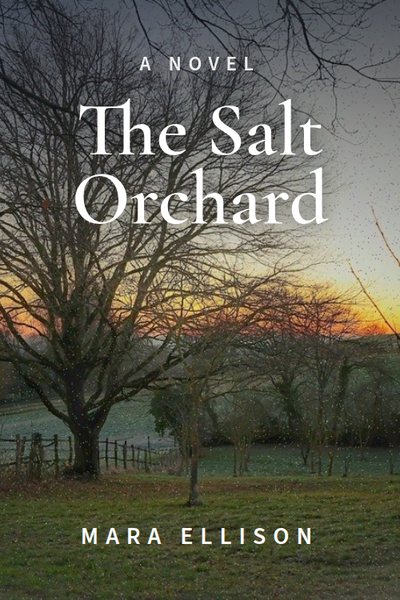
The Salt Orchard, by Mara Ellison
Three sisters come home to their family's apple orchard on the Maine coast for one final harvest, while seawater creeps into the soil beneath the trees. Mara Ellison, a hospice night nurse in Tenney Harbor, wrote the novel over eleven years in the small hours of her shifts. Harbor Light Press published it yesterday. Albright called its restraint "almost physical, like a held breath."
Nine Lamps Over Kettle Street, by Jonah Adebayo-Reyes
In 1924 Harlem, Augustus Bell lights the lamps on Kettle Street every evening and keeps a ledger of the secrets he sees after dark. Jonah Adebayo-Reyes, a former high school history teacher from the Bronx, spent four years in city archives rebuilding the block. The novel, from Lantern House, began with a single photograph of a lamplighter on a ladder.
Low Tide Protocol, by Priya Venkataraman
Flood modeler Anika Rao discovers that her city's evacuation plan was designed to fail, and she learns it as the water is rising. Priya Venkataraman is a working coastal hydrologist in Norfolk, Virginia, and she timed the novel's storm surge against the kind of model she runs at her day job. Northwater Books published it September 1.
What the River Kept, by Delia Montrose
Delia Montrose retraces her late father's route down the Mississippi and braids his story with her own. She published the memoir herself in May and printed 300 copies. The Third Thursday Readers, a fourteen-member book club in her hometown of Alton, Illinois, took it up. It is now in its fourth printing, with more than 9,000 copies sold, nearly all of them within a few hours of the river.
A Grammar of Small Birds, by Tomasz Wren
Tomasz Wren wrote these poems over one winter in Milwaukee, listening to birds outside the hospital window where his wife was recovering. She came home. The collection closes with "Wren, February," a sonnet he drafted 212 times. Wren, who was born in Gdansk, teaches English as a second language. The book is the only poetry on the longlist, published by Finch & Quill.
Glasshouse Summer, by Imani Clarke
A botanist named Nell and a restoration architect named Theo spend one summer bringing a Victorian greenhouse back from ruin. Imani Clarke's query landed her an agent in nine days. After that the book grew slowly, through one bookseller in Durham who kept pressing it into customers' hands, then a book club, then readers online. Rosewater published it in June.
Orbit of the Lesser Moons, by Kai Nakamura-Holt
A lonely engineer on a mining station around a forgotten moon begins finding letters from the station's first crew, dated 41 years earlier. There are no villains and no battles. Kai Nakamura-Holt, a former air traffic controller in Portland, Oregon, wrote a book about the quiet work of keeping things running. Farlight publishes it September 15.
The Undertow Club, by Beatrice Lang
The founder of a century-old winter swim club is found dead inside the club's changing hut, bolted from within. Beatrice Lang set her mystery in the fictional seaside town of Gullhaven, Massachusetts, and she swims year-round herself. The book, from Bellwether, plays scrupulously fair with its clues. Osei said he guessed wrong twice and was "delighted both times."
Ledger of Quiet Things, by Samuel Okafor
Emeka, an accountant in Lagos, keeps a private second ledger of the small kindnesses he witnesses. One day he finds an entry he did not write. Samuel Okafor, a CPA in Houston, wrote the novel one hour at a time, from 5:30 to 6:30 every weekday morning before work. Harbor Light Press published it in March.
Fieldwork, by Hannah Birch
These linked essays follow a 900-mile walk along the field margins and hedgerows of England and Wales, the narrow strips at the edges of farmland that most people drive past. Hannah Birch spent her career as an agricultural surveyor, measuring those edges without really looking at them. Common Ground published the book in August. It is one of two nonfiction titles on the list.
Iron & Honey, by Rosa Delacroix-Vance
In the kingdom of Vell, the bees choose the queen, and a disgraced beekeeper's daughter must decide which hive to betray. Rosa Delacroix-Vance keeps bees in Asheville, North Carolina. She drew the map of Vell before writing a single chapter and invented a beekeepers' language, complete with a glossary. The 496-page fantasy arrives from Farlight on September 22.
The Last Good Summer on Arden Lane, by Colin Mercer
Four boys, one borrowed Volkswagen Beetle and the summer of 1971 in Arden, a steel town in western Pennsylvania. Colin Mercer, a retired machinist, started writing in a community college night class at 61 and published this novel at 67 with Rustbelt Editions. Quintero called the last chapter "the most honest ending I read all summer."
What Comes Next
The judges will name a shortlist of six later this month, and the winner will be announced October 30. Every shortlisted author receives a RedSquibble Cover Story and a year of promotion on the site. The winner also receives an episode of The RedSquibble Podcast and a season of reading events with independent bookstores.
"I expected to be comparing novels with novels. Instead I spent a week trying to decide whether a sonnet can outweigh a locked-room mystery."
Albright would not say which way she is leaning. She would say only that the next round will be harder than the last. "Getting to twelve was a matter of taste," she said. "Getting to six is going to be a matter of conscience."
The 2026 RedSquibble Debut Shortlist will be announced later this month. The winner will be announced October 30.
Books editor. Noor runs RedSquibble's reviews and interviews and chairs the process that produces the annual Debut Shortlist.