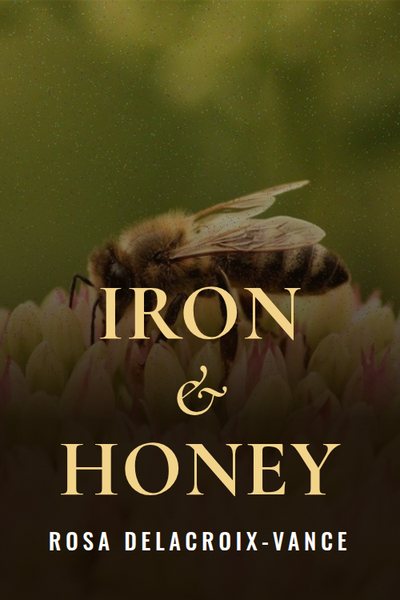

In August, one of Rosa Delacroix-Vance's three hives replaced its queen without asking her. She found out by accident, lifting a frame on a humid Sunday and spotting a long, glossy young queen she had never marked. Somewhere in the heat of July, the colony had decided the old queen was failing, raised a successor in a single cell, and let the transition happen so quietly that the honey never slowed down.
"Beekeepers call it supersedure," she says. "It's a coup with no casualties. I stood there in my veil and laughed, because that is the entire back half of my novel, and the bees did it in about three weeks without a single speech." Her debut, Iron & Honey, is a 496-page fantasy set in the kingdom of Vell, where the bees choose the queen. We talked about politics, length and the insects that taught her how a story moves.
Gold, iron and stone
For a reader who hasn't opened the book yet, who holds power in Vell?
Three kinds of hives, and the people who keep them. The gold hives belong to the palace. They sit on the linden groves around the capital and they make the money. The iron hives belong to the garrison houses in the north, soldiers who keep bees the way other armies keep horses. And then there are the stone skeps, the old straw hives nobody uses anymore except the keepers of the old faith, who believe the bees speak for something larger than any crown. Every faction thinks the swarm is on its side.
Isolde Marrow has to betray one of them. How did you decide which?
I rewrote the ending four times, and each time she betrayed a different hive. The version in the book is the fourth. I won't say which, but I can say how I chose. I asked which betrayal would cost her the most and still be the right thing to do. Only one of the four endings passed both tests. The other three were either too easy or simply wrong.
Where did the real politics of the hive show up most?
Robbing. In late summer, when the flowers dry up, strong colonies raid weak ones for their honey. It's brutal. The guards at the entrance fight to the death, and a weak hive can be emptied in an afternoon. That became the war in Vell. The northern houses are hungry, and their season ended before everyone else's did. Hunger makes a better enemy than wickedness.
"Supersedure is a coup with no casualties. The bees did it in about three weeks without a single speech."
Eight hundred pages and a scalpel
The finished book is 496 pages. Was it ever longer?
The first full draft was 812. I printed it out and it filled two paper boxes on my porch. My editor at Farlight, Iris Tolland, read it and sent me a letter that began, very kindly, "There are two novels here and one of them is wonderful." The other one was a whole second point of view, a young courier carrying messages between the northern houses. I loved him. He took up 230 pages.
How did you cut 316 pages from a debut?
With a spreadsheet, honestly. I listed every scene and asked one question of each. Does this change what Isolde believes? If the answer was no, it went. The courier failed that test almost every time. He saw important things, but he saw them for the reader, and Isolde never found out. He survives now as a single chapter and a name on the map.
Did anyone push you to split it into two books?
Early on. I said no. Fantasy readers are patient with length as long as the length is doing work. What they won't forgive is a book that ends in the middle of a sentence and asks them to wait two years for the rest. I wanted Iron & Honey to be a whole meal.
What the hives know
What did bees teach you about plot?
Pacing, mostly. A hive runs on a nectar flow and a dearth. There are weeks when everything blooms at once and the colony can barely keep up, and then weeks when nothing is flowering and they live on stores. I built the book that way. A flow, then a dearth where the characters live on what they gathered earlier. If a chapter felt slow, I asked whether it was a dearth on purpose or just a dull stretch.
And about minor characters?
A summer worker bee lives about six weeks. She does every job in the hive in order, cleaning, nursing, building, guarding, foraging, and then she dies in a field somewhere. The colony goes on. So I let minor characters in Vell do enormous things in very small spaces. A guard holds a gate for two pages and that's her whole life, and the book is different because she was there.
How many times have you been stung writing this book?
Sixty-three since I started counting. I keep a tally on the inside of the shed door. Most of them were my fault.
The unmarked queen is still laying in the third hive. Delacroix-Vance has decided not to mark her at all. "She took the job without me," she says. "I'm not going to pretend I appointed her."
Iron & Honey by Rosa Delacroix-Vance (Farlight, 496 pages, $30) is out now.
Features writer. Marcus reports on publishing, independent bookstores and how new authors break through.