
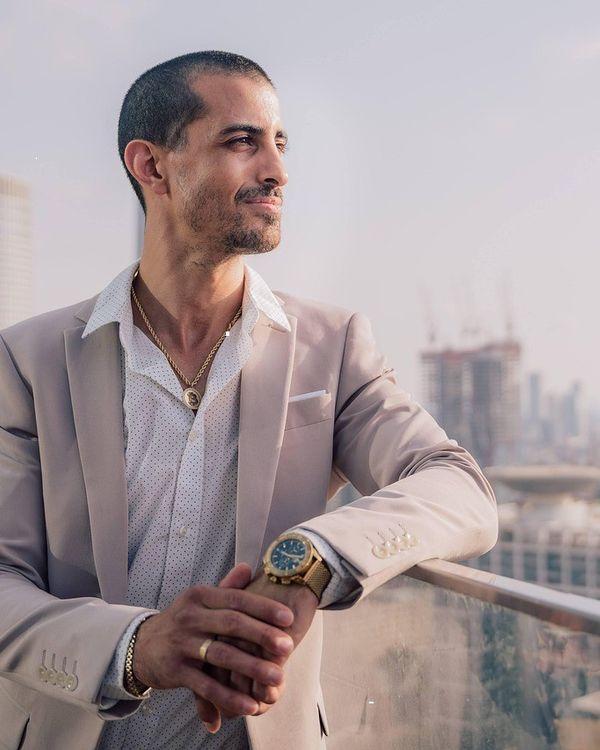
On the shelf above Samuel Okafor's desk in Houston there is a school exercise book with a blue cover and a spine repaired with brown packing tape. Inside, in a small upright hand, are the accounts of a hardware shop on Ogui Road in Enugu for the year 1994. Nails by the kilo. Cement by the bag. Paint, wire, padlocks. Down the right-hand margin of almost every page runs a second, narrower column of names with sums beside them, and not one of those sums was ever crossed out.
"That's my father's handwriting," Okafor says. "The second column is everybody who owed him money that he had already decided never to collect. He never called it charity. He just wrote it down so he'd remember who he had forgiven." Ledger of Quiet Things, his debut novel from Harbor Light Press and a finalist on the 2026 RedSquibble Debut Shortlist, begins with a Lagos accountant named Emeka who keeps a private ledger of kindnesses. It is not hard to see where the idea started.
The city that counts
You grew up in Enugu. Why set the novel in Lagos?
Because Lagos is where I learned what counting really is. After university I spent two years there, from twenty-one to twenty-three, working at a small audit firm in Yaba and sleeping on my aunt's sofa in Surulere. Lagos counts everything. The fare on the danfo, the minutes in the go-slow, the liters left in the generator. Everybody is owed and everybody owes. Enugu was home. Lagos was the place that made me an accountant.
What did those two years give you that research could not?
Sound, mostly. The bus conductor shouting the stops. The women in Tejuosho market who could run a full day of sales in their heads without writing a single figure, and who were never wrong. Emeka works in an office building near the marina, but I made him take the bus I used to take. Some Lagos readers have written to tell me I got the route slightly wrong. I tell them it was right in 2007.
How has your family taken the book?
My father is seventy-nine. He read it twice and then called to tell me the price of cement in chapter four was too low. My three sisters, in Lagos, Abuja and London, formed a group chat just to argue about which of them is the aunt in chapter eleven. None of them is. All of them believe it's her.
Columns and chapters
The novel's double-entry structure has been widely noticed. Is there a rule inside it that readers tend to miss?
Every chapter title is the name of an account. Cash. Accounts Receivable. Suspense. Retained Earnings. If you know accounting, the titles tell you what kind of trouble is coming. And Emeka's second ledger has two columns, Given and Received. For most of the book he only ever writes in Given. He watches kindness. He records it. He doesn't think of himself as someone kindness happens to.
So the entry he didn't write lands on the other side.
Yes. It appears in Received. Someone has been in his book, which is bad enough. Worse, someone thinks he is owed something. That is what frightens him.
"He never called it charity. He just wrote it down so he'd remember who he had forgiven."
Did the structure ever fight you?
Constantly. In the third year I wrote a chapter about Emeka's brother that I loved, forty pages, and it had no matching entry anywhere. It sat in the book like a transaction with no source document. I tried for months to justify it. Eventually I did what you do in an audit. I took it out and put it in a separate file marked Unsupported. It's still there.
What Emeka knew
Is Emeka you?
He's the accountant I would have become if I had stayed in Lagos and never met my wife. More careful than me. Lonelier. Better at his job, honestly. He would never have let a chapter sit unsupported for three months.
What did he teach you?
That I was keeping score in a stingy way. I thought I was a generous person because I remembered the good things I did. Emeka made me notice that I kept a very poor record of the good things done to me. I had a whole column I never wrote in. After the book, I started, in the notes on my phone. A colleague who covered for me in April. A stranger who paid for my coffee at the airport in Atlanta. It changes how you walk through a day.
Do the books have to balance by the end?
In my profession, yes. In a life, I'm not sure they should. That's the last thing Emeka learned, and I think it's the last thing I learned writing him. Some entries you just carry forward.
When the conversation ended, Okafor took the blue exercise book down from the shelf and opened it to December 1994. In the margin column, the last name of the year had no sum beside it at all. His father had only written "all of it."
Ledger of Quiet Things by Samuel Okafor (Harbor Light Press, 288 pages, $26) is out now.
Senior writer. Julian profiles debut novelists and the lives they write around. He spent a decade as a features reporter at newspapers across New England.