Colin Mercer spent forty years as a machinist in western Pennsylvania before he wrote a page of fiction, and his debut reads like the work of a man who knows exactly how things fit together. The Last Good Summer on Arden Lane, on the 2026 RedSquibble Debut Shortlist, follows four boys and one borrowed Volkswagen through the summer of 1971. We chose this opening because it sounds like someone telling you the truth across a kitchen table, and because by the last line you already know the summer will cost them something.
Chapter One
We were fourteen that summer, which is old enough to know everything and young enough to be wrong about all of it.
There were four of us. Me, Nicky Fedorchak, Walt Lisowski, who everyone called Bones, and Tommy Kerr, who was a year behind us in school but had been held back in second grade, so it evened out. We lived within two blocks of each other on Arden Lane, which was not really a lane but a steep street of narrow brick houses that ran from the Slovak hall at the top down to the tracks at the bottom. Below the tracks was the river, and across the river was the mill. At night when they tapped a furnace the sky over it went orange, and the light came in our bedroom windows and lay across the ceiling like something spilled.
My father worked the open hearth. So did Nicky's father and both of Bones's uncles. Tommy's father had worked there until his back went, and after that he sat on their porch in a kitchen chair and watched the street. The mill whistle blew at seven and three and eleven, and every house on Arden Lane set its clocks by it, and so did the churches, both of them, St. Cyril's and the Lutheran one we were not allowed to go into.
That was the town. One main street, two churches, a hall where old men played cards in a language we only knew the swear words of, and a mill that never slept. I thought it was the whole world.
The car belonged to my cousin Eddie.
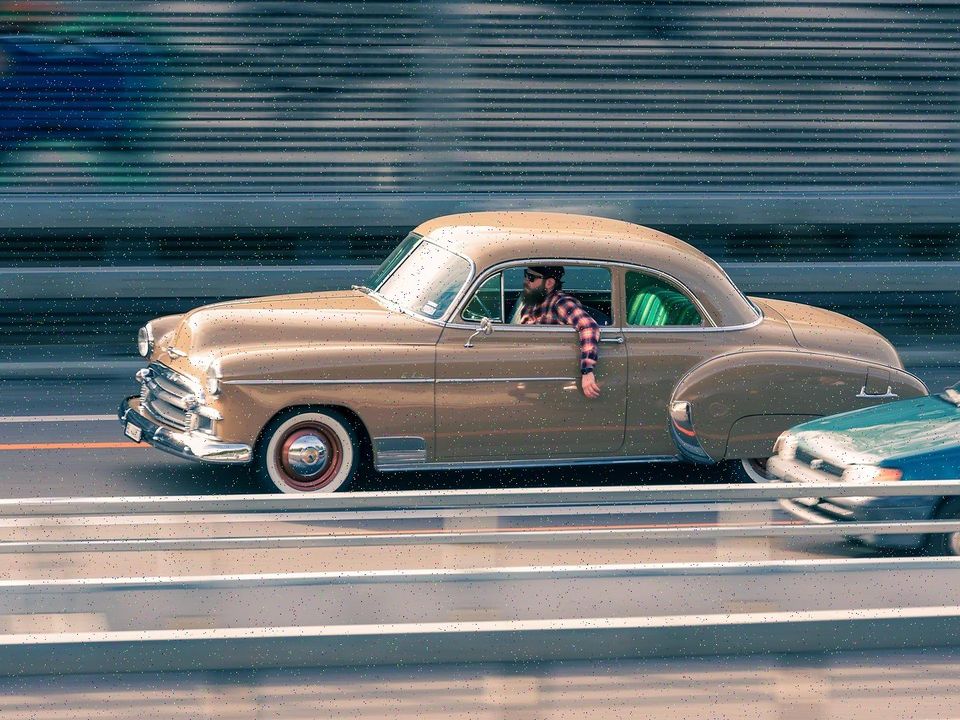
It was a 1966 Volkswagen Beetle, pale blue, the color of a robin's egg left too long in the sun. Eddie had bought it from a priest in McKeesport for four hundred dollars. On the passenger side there was a rust hole in the floor about the size of a saucer. If you sat there, you could look down between your sneakers and watch the road go by, gray and fast, like a river of its own.
On the last day of May, Eddie got on a bus to Fort Knox. He was eighteen. He had gotten his letter in March, and for two months he had walked around town like somebody carrying a full cup of coffee across a room, very careful, not looking at anyone. The night before he left he came up our back steps and knocked on the screen door, and my mother let him into the kitchen.
He held out the keys.
"Somebody's got to start it once a week, Aunt Helen," he said. "Or the battery goes."
My mother dried her hands on a towel and looked at the keys as if they might bite. She did not drive. My father had opinions about German cars that he had formed in a much larger war.
"I'll do it," I said.
I said it too fast. All three of them looked at me. Eddie grinned, the first real grin I had seen out of him since March, and tossed the keys across the kitchen. I caught them against my chest.
"Once a week," my mother said. "In the driveway. You start it and you turn it off."
"Yes, ma'am."
"You don't put it in gear."
"No, ma'am."
Eddie was still grinning. He knew. He had been fourteen once himself, and it had only been four years ago.
We lasted six days.
On the sixth night, a Thursday, the whistle blew at eleven for the shift change, and I lay in bed and listened to the men going down Arden Lane toward the footbridge, their boots on the brick, their voices low. When the street was quiet again I got up and put on my jeans in the dark. I had told the others on Monday, at the ball field, and nobody had said a word for a long time, and then Bones said, "Well, we'd have to push it," and it was decided.
They were waiting at the bottom of our driveway. Tommy had brought a pack of his father's Pall Malls, which none of us smoked, in case the situation called for it.
We pushed the Beetle backward out of the driveway with the headlights off and the door open, me steering from outside with one hand through the window. It was lighter than I expected. At the bottom of the drive the street tipped it downhill and it rolled on its own, and we ran alongside it and piled in, all four of us, doors slamming, Bones in the back with his knees at his chin, Nicky beside him, Tommy in the front passenger seat with his feet on either side of the hole.
I turned the key. The engine caught behind us with a sound like a sewing machine clearing its throat.
I had driven exactly twice in my life, both times in a church parking lot with my Uncle Stan. I found first gear on the third try. We lurched. We stalled. I found it again, and this time we went, down Arden Lane under the streetlights, past the dark windows of every family we knew, past Tommy's porch, all the way down to the tracks.
Across the river they tapped a furnace. The whole sky went orange at once, and the inside of the car filled with it, and I looked over at Tommy and saw his face lit up like something in a painting, his mouth open, his hands braced on the dashboard.
"Look down," he said.
I looked. Through the hole in the floor the road was pouring by, bright orange and then gray, and it seemed to me then that we could have followed it anywhere, and that nothing would ever be taken from us that we were not willing to give.
That was the first night. There were fifty-one more. I have counted them many times since.
The Last Good Summer on Arden Lane by Colin Mercer (Rustbelt Editions, 304 pages, $26.99) is out now.
Books editor. Noor runs RedSquibble's reviews and interviews and chairs the process that produces the annual Debut Shortlist.