
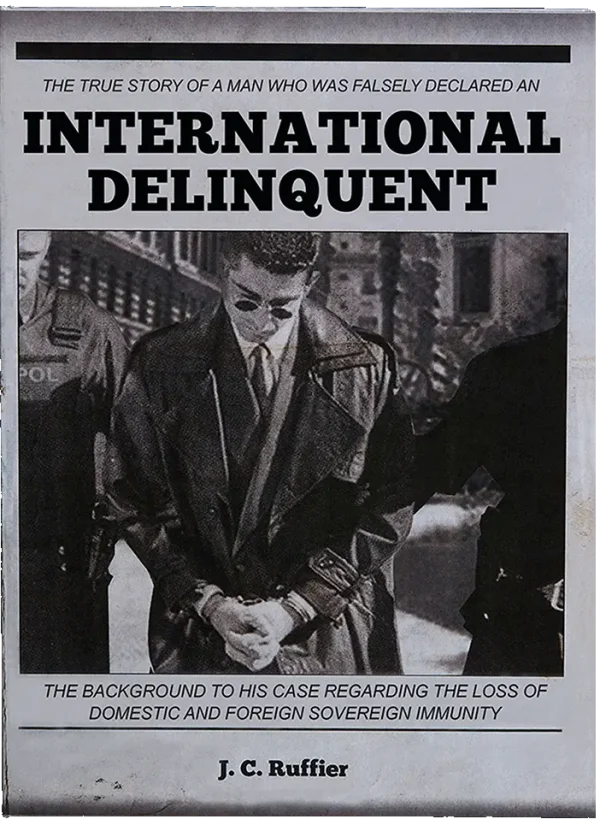
Juan Carlos Ruffier, who writes as J.C. Ruffier, has published International Delinquent, a memoir of nearly nine years apart from his son, as his damages suit over the same events seeks review by Argentina's Supreme Court.
The book is available through the author's own site, internationaldelinquent.com, where it is offered as an e-book in English, Spanish (as Delincuente Internacional), Portuguese, French, Russian and Arabic. The site says the name on the cover is "an abbreviated form of his name chosen to transcend language barriers."
Its cover makes the argument in one line: "The true story of a man who was falsely declared an International Delinquent."
What is International Delinquent about?
It is Ruffier's account of how he lost contact with his son, Jonathan, in December 2005 and spent most of the next decade trying to get him back. The table of contents posted on the author's site runs from a prologue through thirteen chapters with titles such as "Fugitive," "Looking for You," "Lost and Found," "False Declarations," "Encaged," "Supervised" and "Revelations."
The outline of the story has been reported before. Jonathan was born in Buenos Aires in 2002, according to Agencia Nova, an Argentine news agency that covered the case on September 7. After a custody case in Texas and Ruffier's return to Argentina with the boy in 2005, the mother accused him of taking the child from the United States without permission, and international arrest requests followed, the agency reported. In December 2005 he was arrested in Paraguay, where he had travelled with his son, and the boy was taken from him. He spent about 43 days in Tacumbú prison in Asunción before being extradited to Argentina, according to Agencia Nova. (The agency dates the arrest to December 12; earlier coverage in Clarín gives December 19 as the day father and son were separated.)
Several courts later sided with him on the custody questions. In April 2006, a Texas appeals court in El Paso reversed the Texas custody orders, finding the trial court had lacked jurisdiction over the child, and sent the matter back with instructions to dismiss. In December 2008, a federal court in Formosa, Argentina, dismissed the abduction case against him and found, under the Hague Convention on child abduction, that the boy's habitual residence was Argentina, Agencia Nova reported.
None of that brought his son home. Ruffier found him in 2014 on a Russian-language social network, Clarín reported, and the boy, then 12, landed in Buenos Aires from Moscow in October of that year.
Why did he write it?
In a one-page note that opens the book, which the author's site makes free to read, Ruffier says the book began as a story he kept telling. "I told several people my story, and they all asked me to write a book," he writes.
He says he asked a Mexican writer he names as J. Tabares to guide him during the summer of 2020, and that the two lived together for three months during the pandemic, "taking notes of my stories and putting together the skeleton for this book while I relived the suffering I went through." He finished it alone. "Although I am neither a writer nor wish to be one, I continued writing little by little until I finished on my own," he writes.
He is also clear that the book is meant as an act of witness. "I feel it is my duty to write this book, and I do it for the good of all societies in all parts of the world so that this injustice will never happen again," the note says. It closes: "Today I invite you to get to know my story and put yourselves in my shoes. Enjoy the trip."
Why six languages, an audiobook and an album?
The languages are part of the story. Ruffier learned Russian years before his son was born, Clarín reported in 2015, and when he finally reached the boy in 2014, Russian was the only language his son understood. "When he got off the plane, he said to me the only word that is the same in Russian and in Spanish: Papá," Ruffier told the paper (translated from Spanish).
Agencia Nova reported that translations into 14 more languages are under way, with a goal of 20 languages by the end of the year. RedSquibble has not seen those translations.
| Format | Status, per the author's site and streaming services |
|---|---|
| E-book | On internationaldelinquent.com in English, Spanish, Portuguese, French, Russian and Arabic |
| Audiobook | "Currently in production," release date January 2027 |
| Album, International Delinquent | Released February 2022 under the name Ruffier; 12 tracks, about 49 minutes, on Spotify, Apple Music and other services |
| Legal documents | Court papers "presented in their original language," behind a purchase |
| Second volume | Planned; will continue the story from December 2021, Agencia Nova reported |
The album came first. Its tracks, listed on the author's site, include "Free," "It's Too Late," "Nothing to Hide," "Run Away" and "Don't Look Down," along with orchestral and instrumental versions of "Said and Done."
The site also offers access to legal documents from the case. Agencia Nova said the aim is to let readers compare Ruffier's account with the evidence and reach their own conclusions.
What is the case Ruffier wants Argentina's Supreme Court to hear?
It is a damages suit Ruffier filed in 2016 against both the Argentine state and the United States, which he holds responsible for his arrest and nearly nine years of separation from his son. The case is Ruffier, Juan Carlos c/ EN y otro s/ daños y perjuicios (file CAF 61373/2016), before a federal administrative court in Buenos Aires.
Ruffier argues that his arrest and the removal of his son rested partly on documents from the United States that left out essential facts, including that the Texas custody orders were under appeal. His appeal, which RedSquibble has reviewed, says those documents were delivered to an Argentine court by the FBI's legal attaché in Buenos Aires. It also alleges that a U.S. federal agent intercepted his phone calls and read his private email while he was in Argentina, without authorization from any Argentine judge. These are his allegations. No court has ruled on them, and the Argentine state denies it is liable.
The fight so far has been over whether the United States can be sued at all. In July 2019 the U.S. Embassy told the court it would not waive sovereign immunity, the rule that generally shields one country from the courts of another. Even so, after a federal prosecutor supported letting the case continue, the trial court on October 12, 2021, ordered the complaint served on the United States and gave it 60 days to answer.
Four years later the same court changed course. On October 16, 2025, it granted the United States immunity. Ruffier's lawyers say the reversal was never explained. On June 30, 2026, Chamber I of the federal administrative appeals court upheld the ruling and ordered Ruffier to pay costs. According to his appeal, the chamber found that the record did not show "with the necessary clarity" that the wrongs he alleges happened on Argentine soil.
That finding is the heart of his appeal. Argentina's Law 24.488, Article 2(e), lifts a foreign state's immunity for damages from crimes or other wrongful acts committed in Argentina. His lawyers argue that wiretapping and reading the email of a man who was physically in Argentina fits that exception.
Represented by María Laura Garrido and Rolando David Garrido, Ruffier filed a 26-page recurso extraordinario federal, signed on August 3, 2026. It argues that the courts misread the law and, in the alternative, that the ruling was arbitrary because it ignored the evidence he offered. As of October 23 the appeal is still before Chamber I, which must decide whether to send it to the Supreme Court. If it refuses, Ruffier can ask the Supreme Court directly through a recurso de queja.
Argentina's Foreign Ministry, which defends the Argentine state in the case, has stayed out of the immunity fight. In a September 2 filing it said it represents Argentina, not the United States, and declined to answer the appeal. On September 17 the appeals court ordered an official letter to the ministry so that the appeal could be served on the United States through diplomatic channels. Ruffier's side says the ministry has refused to pass the notice to the U.S. Embassy. RedSquibble has not seen correspondence confirming that, and the ministry has not commented.
Ruffier's claim against Argentina continues in the same lawsuit. Unlike the United States, Argentina cannot claim foreign-state immunity in its own courts.
He has been before the Supreme Court before. In December 2014 it sided with him in the custody case, ruling that Argentine courts should hear it.
What the book says about the U.S. criminal case
The title points to a second legal history, one the book takes on directly. Federal court records in El Paso show that Ruffier was indicted in Texas in 2006 and taken into federal custody there in March 2017. Ruffier says he surrendered voluntarily to FBI agents waiting at an international border crossing. The records show he first pleaded not guilty and was held without bond. The Associated Press reported at the time that he faced federal kidnapping charges over taking his son abroad in 2005.
Ruffier says the case ended in 2018 with a guilty plea under Rule 11(c)(1)(C) of the Federal Rules of Criminal Procedure. That kind of agreement fixes a sentence that binds the judge once accepted. He says he faced up to 25 years, that U.S. District Judge Frank Montalvo sentenced him to 12 months and one day, and that, having already spent about 10 months in custody, he was released with credit for time served. RedSquibble has not seen the plea agreement or the judgment.
International Delinquent gives his account of that case: his time in federal prison, the proceedings against him and the negotiations that led to his release, including why the sentence was so much shorter than the one he faced. The documents offered on his site include court records that, he says, contradict parts of earlier press coverage.
The note at the front of the book anticipates a hostile reception. "I am sure that writing about what occurred will have severe consequences," Ruffier writes.
The book covers events through December 2021. A second volume will pick up from there, and Ruffier has received offers to adapt the story for film, a miniseries or a telenovela and is weighing them, Agencia Nova reported. His lawsuit against the United States and Argentina goes on.
International Delinquent by J.C. Ruffier is available at internationaldelinquent.com. The audiobook is due in January 2027. Cover image courtesy of the author's site, internationaldelinquent.com.
Reporting by the RedSquibble books desk.