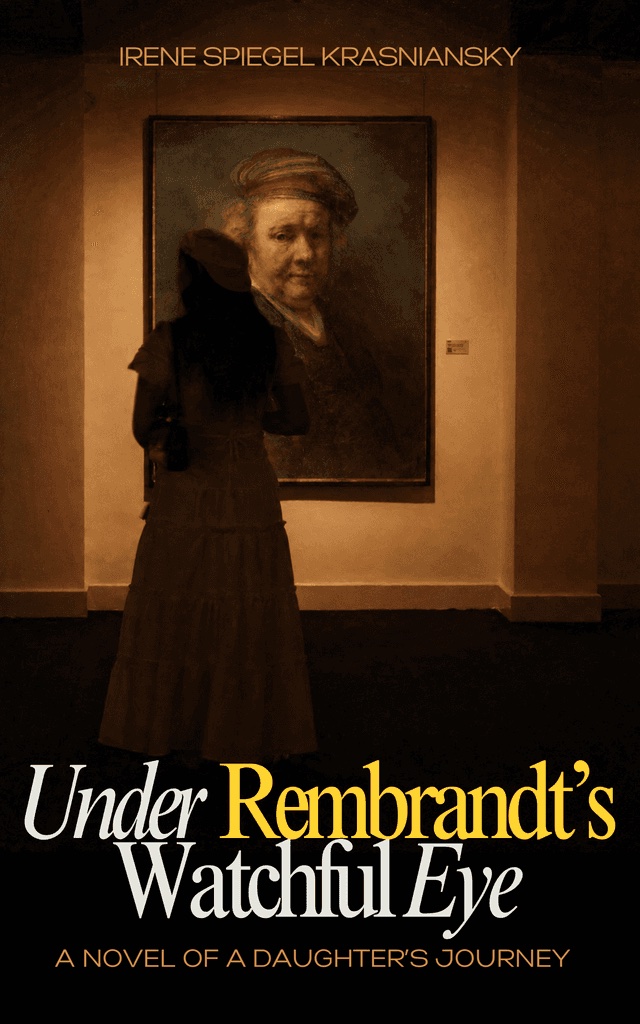
Two girls are nine years old when Under Rembrandt's Watchful Eye begins. One is Cornelia, the daughter of Rembrandt van Rijn, growing up inside the painter's household in seventeenth-century Holland. The other is Neely, growing up in Los Angeles in the 1990s, in a home shaped by the craft of her immigrant father and her artisan grandparents.
Irene Spiegel Krasniansky's debut novel follows both of them, chapter by chapter, until they are women and mothers. Her own description of the book is a promise about how it should feel to read. "It's meant to be an immersive story, almost as if you're looking over the shoulders of the people living it."
Krasniansky published the novel herself, bringing it into the world on her own terms, much as her Cornelia has to make her own way in a world run by men. The paperback came out on October 21, 2026, at 348 pages. A Kindle edition is also available. Her website, irenespiegel.com, calls it "a sweeping novel about memory, legacy, and the enduring mystery of the human soul."

Cornelia's fight in Rembrandt's house
The first story opens the door to the painter's home. "Through the eyes of his daughter, Cornelia, we enter a world of extraordinary artistic talent, complicated family relationships, and a dangerous struggle over the Van Rijn legacy," Krasniansky says. "She finds herself fighting for her future and ultimately her survival."
The real Cornelia left only a thin paper trail, mostly baptism, guardianship and marriage records, so what she feels and fears on the page belongs to the novelist. "Because Cornelia is not a figure whose life is extensively documented, there was an interesting balance between what could be established historically and what I had to imagine as a novelist," Krasniansky says. Her website says her Cornelia eventually "leaves Amsterdam to build a remarkable life in the Dutch East Indies after her father's death."
Growing up in 1990s Los Angeles
"The second story follows Neely growing up in Los Angeles in the 1990s," Krasniansky says. "I wanted to capture that particular energy and atmosphere of LA during that decade. It was such a colorful time, with an incredible mix of music, fashion, movies, and pop culture."
Art is in the house from the start. "Neely is also immersed in a world of art from an early age, surrounded by the creativity and craftsmanship of her immigrant father and artisan grandparents," she says. "As she grows older, art becomes an important part of her identity and her journey toward understanding who she is." Her website picks Neely up later, in modern-day Los Angeles, as a woman who "has built the life she always dreamed of, yet she is haunted by memories and emotions she cannot explain."
A novel, not a history lesson
"Although the novel is rooted in historical research, it isn't a history book or a lesson in art history," she says. "I want readers to feel like they're right there with the characters, experiencing their joys, heartbreaks, relationships, and struggles as they unfold. The history and art are woven naturally into the story, rather than presented as information readers need to study."
She returns to the point. "I didn't want the book to feel like a history lesson. I wanted readers to forget they were learning history and become completely immersed in the lives of these characters."
The paintings carry the story across the centuries. "Through Cornelia, we experience the paintings in the time and circumstances in which they were created. But through Neely, we get to see those same works centuries later, as they exist in our modern world," she says. For readers who want to look further, she has "included a painting glossary at the back of the book so readers can explore the actual works of art referenced throughout the novel." The Metropolitan Museum of Art holds one of Rembrandt's portraits of Hendrickje Stoffels, Cornelia's mother. The Montreal Museum of Fine Arts holds his Portrait of a Young Woman, painted about 1668. The museum says the sitter's identity remains unconfirmed, and some have proposed his daughter-in-law, Magdalena van Loo. Krasniansky takes a less conventional view: she believes the young woman is Cornelia.
Challenging the familiar Rembrandt
"Rembrandt has been portrayed so many times as an angry, volatile, miserable man that the image has practically become part of his identity," Krasniansky says. "I question that version of him. I think we've allowed his financial troubles, personal losses, and hardships to define the man himself.
"Yes, he experienced tremendous tragedy. But why have we come to assume that suffering made him an angry or unpleasant person? Historical hardship is not a personality.
"After immersing myself in Rembrandt's world, I came away with a very different impression. I see a man who was deeply human, caring, fiercely devoted to his art, and certainly stubborn. I don't see the one-dimensional, embittered character that has become so familiar in novels.
"I realize my interpretation is controversial, particularly among Rembrandt scholars. But I wasn't interested in repeating the same portrait simply because it has been repeated so many times. I wanted to challenge readers to reconsider the Rembrandt they think they know."
The soul and what we leave behind
"As the two stories unfold, questions emerge about the connections that transcend time, the continuation of the soul, and the legacies we leave behind," she says. "Perhaps it's not just about what we leave behind, but what continues through us."
Rembrandt's work helped plant the idea. "When I look at his paintings, I sometimes feel an unexpected sense of connection that goes beyond simply admiring the artistry," she says.
"Interestingly, this book has been living in my head for more than ten years," she says. After three earlier attempts, "when I finally sat down to write it this last time, the words just spilled out like a river."
Who is it for?
"I think this book will appeal to anyone who has ever encountered Rembrandt's work, whether in a museum, an art book, or simply through his reputation as one of the greatest artists in history," Krasniansky says. "His paintings are displayed in some of the world's most celebrated museums, and his name is often associated with art appreciation, culture, and intellectual sophistication. But you don't need to be an art expert, know the history of his paintings, or consider yourself particularly cultured to enjoy this story. I wanted to make Rembrandt and his world accessible to everyone, not just people who already know art."
"I also hope readers think about the women history has left in the shadows, particularly those who lived alongside famous men but never received recognition, and that the book resonates with women who have set aside their dreams for life's responsibilities, reminding readers that they possess just as much creativity, resilience, intelligence, and genius as men."
Under Rembrandt's Watchful Eye by Irene Spiegel Krasniansky is available in paperback and as a Kindle e-book on Amazon. More at irenespiegel.com. Cover image courtesy of the author's site, irenespiegel.com.
Reporting by the RedSquibble books desk.